Building the Identity of Alam Ina Group
Some identities begin with visibility.
Others begin with origin.
Alam Ina Group operates at the beginning of a global chain:
working directly with farmers and local communities across the Moluccas to export coconut-based raw materials to the world.
Because of this position, the brand could not rely on decoration or marketing language.
It needed to communicate trust, stability, and transparency from the first encounter.
Our role was therefore not to invent a story,
but to reveal the structure that already existed.
A Language of Clarity
The typographic system was built around neutrality and readability.
The primary typeface, Aspekta, was chosen for its calm, non-decorative form—capable of conveying institutional reliability and global professionalism rather than stylistic branding.
Used with generous spacing and balanced hierarchy, the typography shifts away from a startup or tech tone and instead communicates something quieter:
long-term trust.
To support this clarity across interfaces and communication, Geist was introduced as a secondary typeface for body text and digital environments, valued for its legibility and modern restraint.
Together, the system forms a typographic voice that does not attempt to impress—
only to remain clear wherever the brand appears.
A Mark Rooted in Place
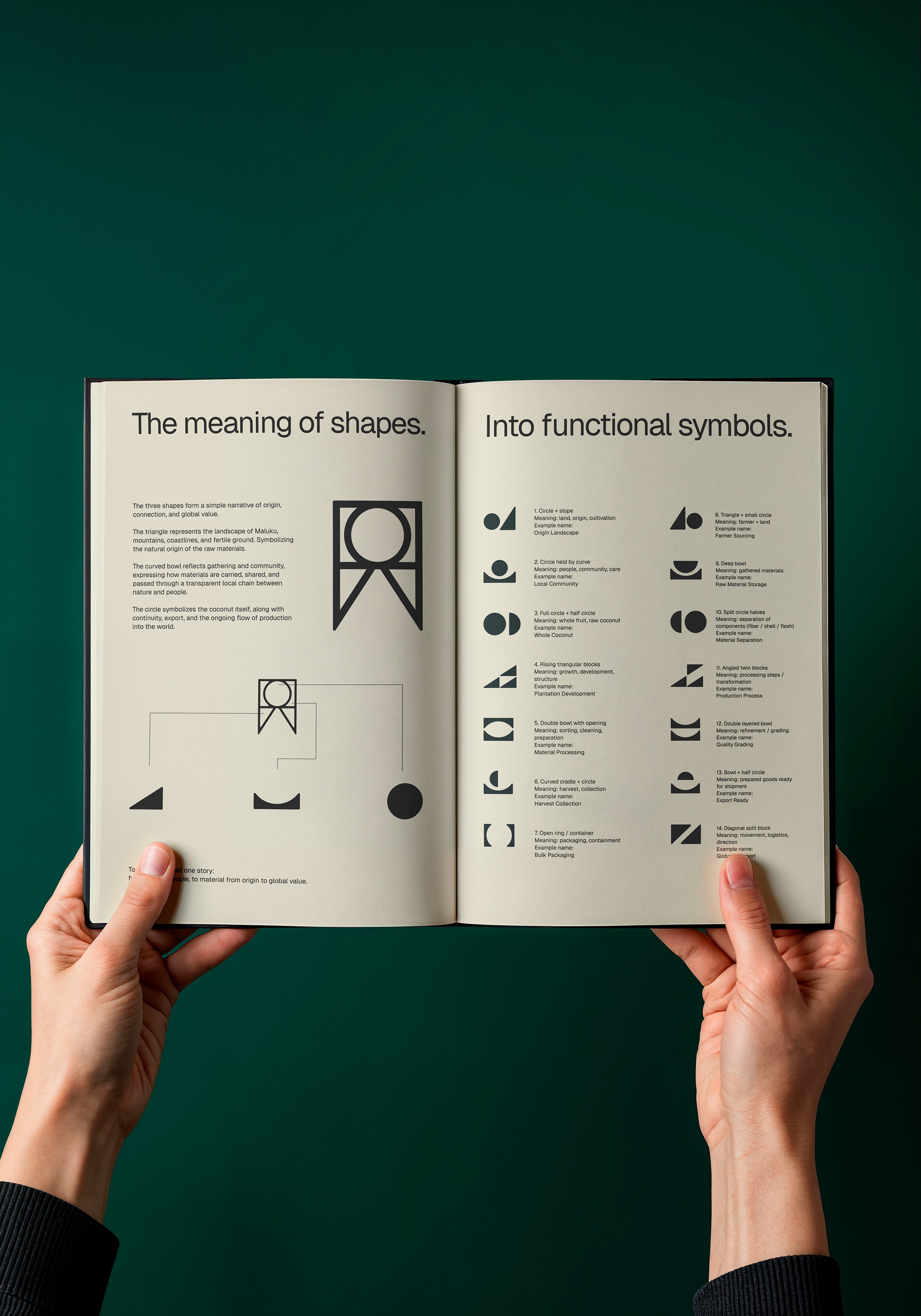
At the center of the identity sits a simple composition of three shapes.
Each element carries meaning drawn directly from the physical and social landscape of Maluku.
The triangle reflects mountains, coastlines, and fertile land, the natural origin of the materials.
The curved bowl represents gathering and community, expressing how resources move through a transparent local chain.
The circle symbolizes the coconut itself, along with continuity, export, and the ongoing flow toward the global market.
Together, these forms narrate a complete journey:
from land, to people, to material.
From origin to global value.
The simplicity of the mark ensures recognition,
while its structure preserves meaning.
Color as Environment, Not Decoration
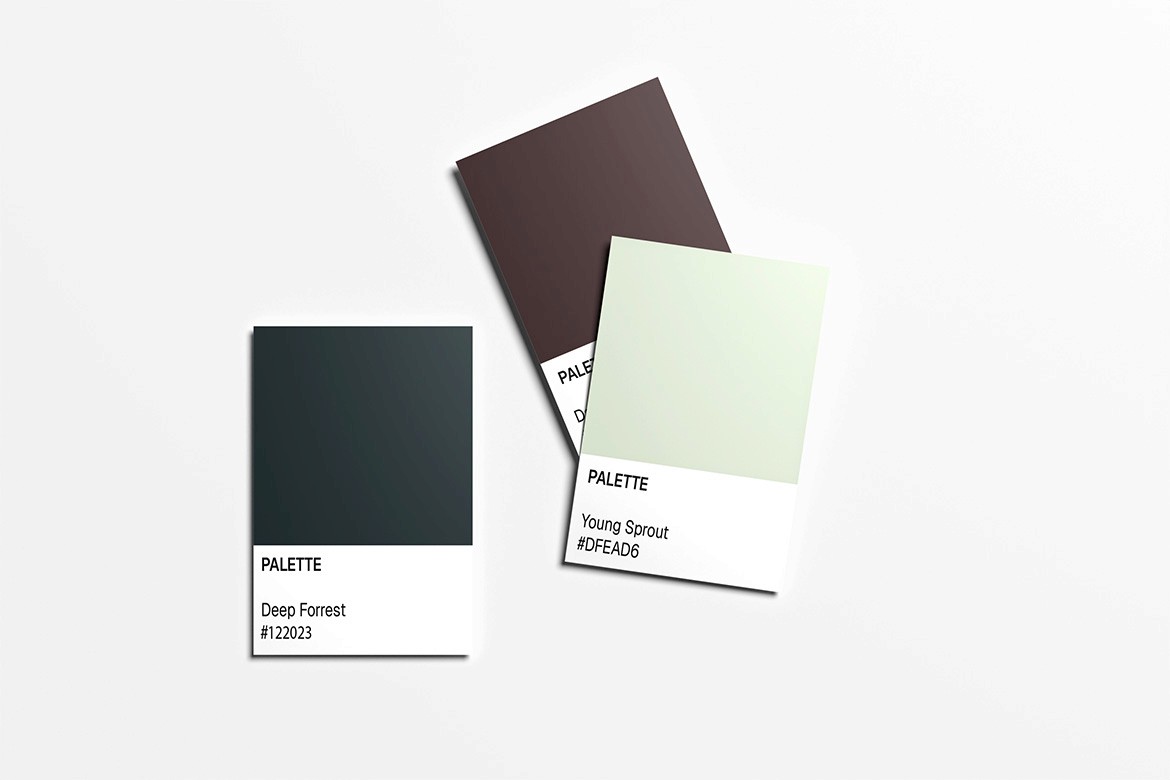
Rather than expressive branding colors, the palette draws from the material world itself:
deep greens for nature and fertility
earth browns for ground and reliability
sand and beige tones for calmness and purity
warm whites and soft greys for balance and professionalism
This creates an organic yet controlled visual system,
one that feels connected to land and production while remaining suitable for international trade.
Color here does not decorate the brand.
It situates it.
Saying Only What Is Necessary
The tagline, Coconut raw materials, was intentionally direct.
Instead of marketing language, it states clearly what the company provides, reinforcing honesty, reliability, and transparency within the global supply chain.
Its use is carefully controlled:
shown when clarity is required, such as on the website header, business cards, or trade materials and removed when restraint strengthens perceived confidence and maturity.
This balance between explanation and silence reflects a broader principle:
trust grows where excess is removed.
Extending Meaning Across the System
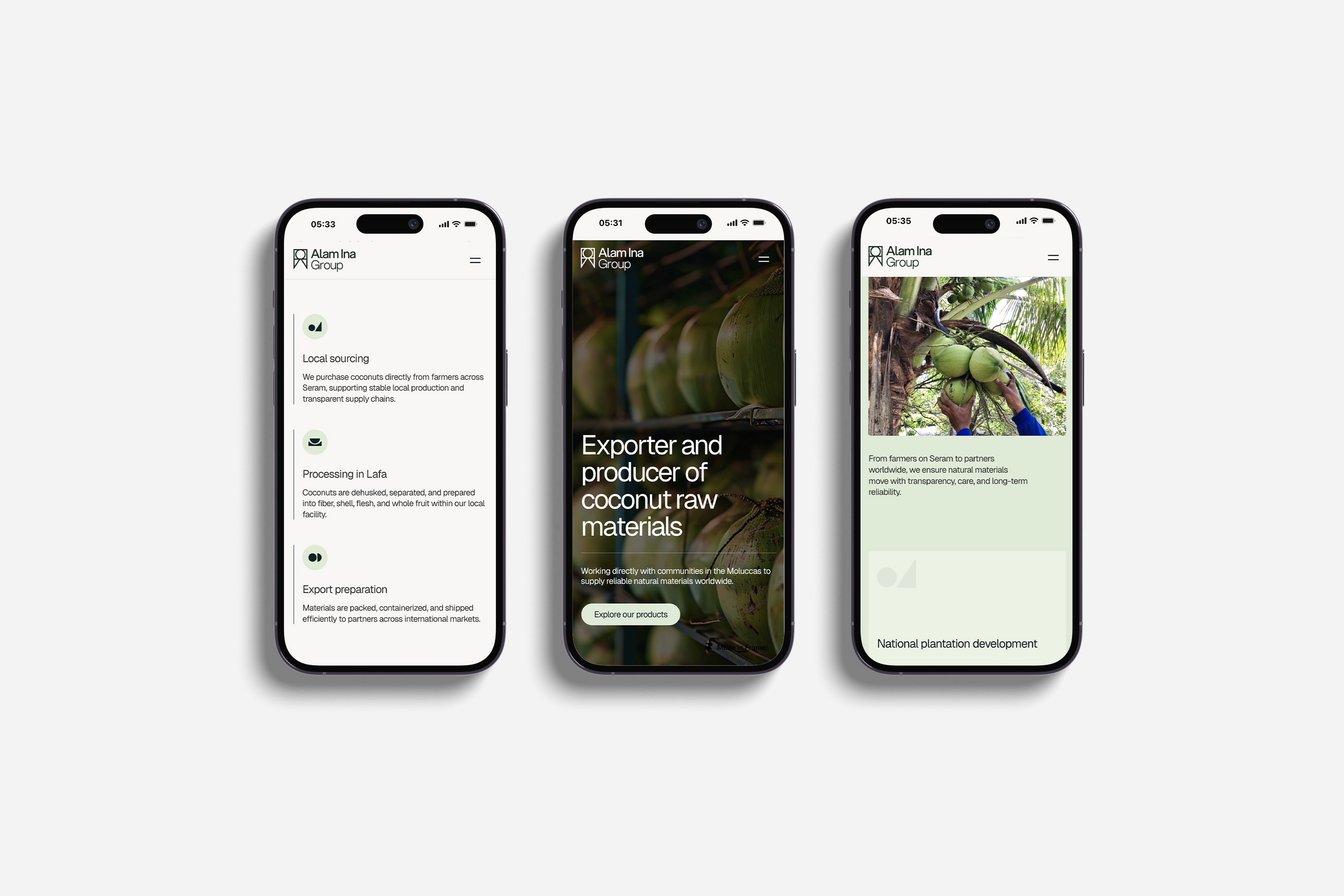
Even the iconography emerges from the same foundational shapes as the logo, ensuring coherence from mark to interface, from print to digital application.
Rather than relying on generic symbols, the system maintains recognition and authenticity at every scale.
In this way, the identity behaves less like a graphic layer
and more like a continuous visual language.
Designing for Continuity
The Alam Ina identity was never meant to appear loud or expressive.
Its role is quieter and more demanding.
To signal reliability across borders.
To connect local cultivation with global distribution.
To remain stable as the company grows.
Design, in this context, becomes a form of infrastructure:
invisible when functioning well,
essential when absent.
And perhaps that is the most accurate measure of success,
not how strongly an identity is seen,
but how confidently it is trusted.
2025